Open Minded #2 – Dr Samuel A. Moore
The Profile of an Open Access Radical
For many researchers, open research is associated with a definitive set of practices, among them sharing data and making code available. Even more typically, open research is thought to come down entirely to a single question: have you published open access (in a reputable journal)? As important as limited set of open practices are, for Dr Samuel A. Moore, Scholarly Communication Specialist with the University of Cambridge Open Research team, openness is about something much deeper.
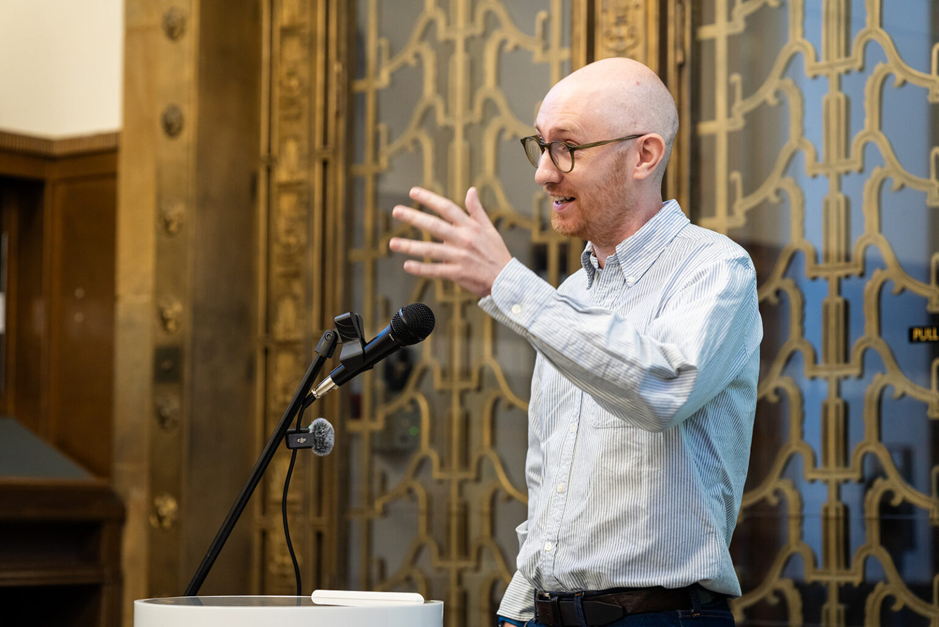
For much of his career, Moore has been thinking critically and writing about open access, publishing, and knowledge production in the humanities. His work spans scholarly communication, digital culture, and research practice. He is also Principal Investigator of MORPHSS (Materialising Open Research Practices in the Humanities and Social Sciences), a project that explores what openness looks like in the rich tapestry of arts, humanities, and social science research. For Moore, openness in both STEMM (Science, Technology, Engineering, Mathematics, and Medicine) and AHSS (Arts, Humanities and Social Sciences) disciplines should not simply be about making research outputs available. It should be about creating space for experimentation, collaboration, reflection, and ultimately greater academic self-determination.
To be a radical is to explore different cultures of knowledge production and to not just accept the way things are just because your PhD supervisor has told you so, or because you’ll get a career if you do X, Y, and Z. – Dr Samuel A. Moore
Becoming Open
Moore’s journey into open research occurred somewhat unexpectedly but is rooted in his passion for arts and the humanities. After graduating from university, he spent time pursuing music before deciding he needed a more stable career. That led him to an entry-level position at the open access publisher PLOS, then one of the pioneers of open access publishing in the sciences. This was a time when there was optimism surrounding open access. “There was a feeling that what we were doing mattered,” he recalls. Open access promised to bring research to people who needed it, particularly in medicine and healthcare, but Moore found himself asking a different question: what might openness mean for the humanities? Having studied philosophy and English literature, he was aware of the contrast between scientific publishing cultures and humanities scholarship.
This curiosity eventually became the basis of his doctoral research, where he examined open access policies in the humanities and their impact on openness. His research was critical of the way open access was managed by the UK government. While government mandates succeeded in expanding access to research, they did so by introducing compliance-driven approaches that risked creating an obligation in researchers, without them fully understanding why. It was at this time that he became interested in scholar-led and non-commercial publishing initiatives that offered alternative visions of openness. These grassroots initiatives demonstrated that open scholarship could be more organically aligned to the idiosyncrasies of different disciplines, instead of being agnostically imposed onto researchers according to market logic and technological mechanisms.
An Open Culture
When Moore first became involved with open access in the late 2000s and early 2010s, openness was connected to a broader cultural moment where openness was explored in unconstrained ways. Creative Commons licensing, open educational resources, free culture movements, blogging, podcasting, and collaborative online communities were all gaining momentum. There was widespread enthusiasm about the possibilities that technology might offer for sharing knowledge. The culture around openness, itself, was very much open and undefined. “There was a sense that openness hadn’t yet been completely locked down as a commercial activity,” Moore says. “People felt they could still shape what it might become.”
Looking back, Moore describes the period as exciting but also complicated. Already he started to observe two camps emerge, one where there was an optimism that technology could solve the issues related to scholarly communication, and another where there was a concern that this technological optimism risked becoming commercially driven. It was in the latter where Moore felt aligned with, which provided the impetus for Moore’s developing career.
Around this time, a growing number of scholar-led presses emerged across the UK and Europe. Small independent publishers experimented with new models for sharing humanities research. Many emphasised collaboration, collective ownership, and non-commercial forms of organisation. Although many of those organisations still exist today, he believes the atmosphere has changed. Financial pressures across higher education have dampened the optimism that once surrounded open access has. Today, Open access has become mainstream, but along the way, some of the energy that drove the cultural movement has subsided.
A philosophical approach to openness: Openness as academic experimentation
While open access was Moore’s entry point into open research, philosophy remains a strong intellectual influence on how he understands openness. During his studies, Moore was drawn to continental philosophy and the work of Jacques Derrida. Although Derrida’s concept of openness differs from contemporary discussions about open research, Moore believes it offers transferable insights. For Derrida, openness is linked to interpretation, uncertainty, and the impossibility of fully closing off meaning. Moore sees a connection between this philosophical understanding and contemporary debates about research. Too often, he argues, institutions treat openness as a fixed set of rules or practices. Researchers are told what they must do rather than invited to explore what openness might mean in their own contexts. “Openness itself has to remain open,” he explains. This perspective leads him away from rigid definitions of openness and towards a more experimental understanding of research culture. For Moore, openness and the spirit of experimentation are inseparable. While he is a firm advocate for sharing publications, data, and research outputs, he sees these activities as only one part of a much bigger picture. The deeper value of openness lies in its ability to challenge assumptions about how knowledge should be produced.
Academic careers are often structured around established hierarchies and conventions. Researchers are pressured to publish in particular venues, work in certain ways, and conform to existing norms. In some disciplines, single-authored books may be valued more highly than collaborative projects in certain disciplines, and traditional publications may receive greater recognition than newer forms of communication. These conventions can become so familiar that they appear natural, but at the same time, are also reified and closes off the discussion of how the researcher’s work should be valued. On the other hand, for Moore openness creates opportunities to question them.
Academic research, he argues, is often constrained by deeply entrenched norms about what counts as valuable scholarship. These norms affect where researchers publish, how they collaborate, and even what formats of knowledge are valued. Ultimately, these norms may be counterproductive to scholarship, as he explains “these are really reified practices that are actually very harmful because they prevent us from exploring different ways of producing knowledge.”
Instead of treating publishing conventions as fixed, unquestionable practices, Moore wants to encourage a culture where researchers view them as questions which are fluid and flexible.
“Rather than publishing a journal article, why not publish a podcast? Rather than publishing a book that looks like a book, why not explode that completely and make it a born-digital, non-linear, continually updated thing that’s not fixed in time?”, he provokes. But Moore here is not encouraging researchers to abandon traditional outputs. Instead, he wants to empower researchers to be able to assess and decide what other approaches might better serve their scholarly objectives, saying “openness for me is almost synonymous with experimentation.” This is especially significant for the humanities and social sciences, where collaboration and collective forms of knowledge production are undervalued. Moore, on the other hand, envisions a culture where researchers see themselves as knowledge producers that are nodes within a larger network of ideas and thinkers.
We won’t really get anywhere unless people care a little bit about why they’re doing what they’re doing and be self-reflective. Once you have that, you’ll have a bunch of very self-reflective people who can get together. And then that’s where change happens. – Dr Samuel A. Moore
What makes Radical Open Access “radical”?
Along with his colleagues Janneke Adema, Rebekke Kiesewetter and Tobias Steiner, Moore is central to the Radical Open Access Collective, a network that emerged from the cultures of openness during the formative years of his career. Despite the name, he does not see radicalism in scholarly communication as one based on a political ideology. Instead, he sess it as a return to the etymological meaning of the word radical: root.
“The meaning of the word radical points to the origins of where a thing comes from and identifying the integral thing that it should be. If you can think about radical open access in these terms, then it is really about getting back to the roots of what openness is rather than the commercial plant that grew out of those roots.”
In this sense, radical open access means understanding what “being open” means in scholarship, which would also entail rethinking the underlying values that motivate scholarship and knowledge production. Radical here means asking how research can be shared in ways that contribute to knowledge rather than simply following the norms where the terms are set not by scholars, but by the logic of commercialisation. For Moore, the goal of radical open access was never to overthrow the publishing industry, but to imagine alternatives and demonstrate that different approaches are possible. Being radical is challenging the idea that the existing systems of scholarly communication are unquestionable, as Moore explains, “to be a radical is to explore different cultures of knowledge production and to not just accept the way things are just because your PhD supervisor has told you so, or because you’ll get a career if you do X, Y, and Z.”
For Moore, the ultimate goal is for researchers to be cognisant of the forces shaping their scholarly decisions and remaining open to exploring other possibilities, saying “researchers need that awareness of the various push-pull factors behind what they’re doing and the broader political economy of publishing. If you have that awareness and then make decisions based on that, that’s what I would consider a radical approach.”
Redefining Openness through the MORPHSS project
One common assumption in the discourse around open research is that openness naturally belongs to STEMM disciplines and does not apply to research that is qualitative or critical. This assumption, that is very much question that has driven Moore’s career since the days as a junior editor at PLOS. At that time, he was an early sceptic of the idea of openness cannot apply to the humanities. Today, he is convinced that while scientific disciplines have been at the forefront of the open research discussion, many of the underlying challenges are shared across all fields. No matter your discipline, researchers everywhere face pressures created by publishing systems and researcher assessment mechanisms. Moreover, open research discussions frequently emphasise tangible and quantifiable outcomes that favour STEMM research: reproducibility, transparency, and data sharing. While these are valuable outputs that should be made open wherever a research project produces them, its prevalence in discussion around openness has led to open research being narrowly defined through them at the expense of excluding research in the arts and humanities. To change the narrative, he has put together a project to explore what openness looks like within these disciplines that have been thus far excluded from the Open Science discussion in what became the MORPHSS project. As he explains,
“We feel that the dominant cultures of open research are scientific cultures and STEMM cultures. This means that people who don’t necessarily conform to those disciplinary requirements are not as enthused by openness as they could be. We want to be able to present an approach to open research for the arts and humanities and social sciences that really speaks to what they do, and also encourage them to engage in some of those practices. It’s about saying that openness can be reframed differently for you. It can be made better in various ways, but ultimately, we want to bring you into this so that you can explore it for your own, for its own sake or for how it fits with your own working practices.”
Initially, the MORPHSS team expected to find that openness in the AHSS space being limited to unconventional research projects. Instead, they discovered that many commonplace research practices in the humanities and social sciences already embodied important forms of openness. Qualitative research methods, positionality statements, community engagement, collaboration with participants, public exhibitions, and alternative forms of dissemination all reflected values directly associated with open research. He says, “traditional research practice, i.e. the non-radical practice, was always open to begin with. It was just not thought of as open science or open, because scientific cultures have dominated the discussion on openness. What we’re trying to show is that these researchers are doing this already, but they just need to think about it in those terms.”
The challenge, then, becomes not necessarily changing how research in the AHSS is conducted, but about broadening understandings of openness so that existing practices are recognised as acts of openness, while also valued as meaningful scholarly outputs. He explains, “we’re trying to highlight that the things that sounds like they’re radical at first are not actually that radical…They are very much mundane, normal practices that the average scholar does, but they are not thought of as open research. We want to say keep doing this and thinking about it as open. The idea is not that researchers should change their behaviour. It’s more that policy makers or open science advocates or institutions should be changing what the meaning of open science is or open research is to reflect that broader culture.”
For Moore, the MORPHSS project is far from over. Future iterations of MORPHSS aspire to bridge the gap between STEMM and the humanities. Part of this effort would be to highlight that the challenge they face may not be too different. In the first place, the divide between the disciplines may not be universal and may only be restricted to the Anglophone world. In European contexts, the seem to matter less, as he explained “in Europe, where they have these cultures that do not exclude the humanities and social sciences, they get that we are talking about AHSS disciplines. Science for them just means all academic disciplines. Open science for them does not mean literally scientific.” While the distinction between STEMM and AHSS remain prevalent in the Anglophone world, the MORPHSS team is aiming for a more nuanced approach that recognises that diversity exists within disciplines as much as between them. As he put it, “the distinction between STEMM and AHSS doesn’t really matter because the distinction between STEMM and STEMM is there as well. We’re all very different and diverse.”
The Radical act of Academic Self-Determination
Throughout our conversation, one theme repeatedly surfaced: scholarly self-determination. This is what, above all, makes Sam Moore an Open Research radical. He is not interested in telling researchers exactly how to conduct their work. He does not even believe there is a single correct model of openness that can be prescribed to all research disciplines. What matters is, firstly, being aware that there are forces at play that define who you are as a researcher, and then to care enough to ask questions about how much these forces compel you.
“I want people to care about the conditions of their own knowledge production,” he says. “To understand how they’re interacting with research, with publishers, with other researchers, and how those relationships might be different. It’s part of being a researcher. It is about learning what happens when you publish, share, and collaborate in these ways, on how they could all be done differently. And when you care about that, when you have a basis of knowledge, then that might lead you to do innovative things. It might lead you to experiment with different ways of knowledge dissemination.”
That awareness may lead some people towards open access publishing. Others may experiment with less traditional forms of communication, collaboration, or engagement. Still others may simply develop a deeper understanding of the systems in which they work. The point is that they decide for themselves, and to do so in ways that fit with their research or, indeed, their goals as a researcher. Awareness is the goal, because without awareness we cannot arrive at self-determination and cultural change, saying, “we won’t really get anywhere unless people care a little bit about why they’re doing what they’re doing and be self-reflective. Once you have that, you’ll have a bunch of very self-reflective people who can get together. And then that’s where change happens. I don’t want to pre-ordain what that change should be, but I do think that academic knowledge production is broken in myriad ways.”
For Moore, open research is ultimately about creating space for researchers to make more informed, reflective, and creative choices about how knowledge is produced and shared. In a higher education landscape dominated by metrics, compliance requirements, institutional pressures, and in some cases, career pressures, creating space for academic self-actualisation may be the most radical act of all.
To find out more about the MORPHSS project and its current and future deliverables, visit: https://morphss.hcommons.org/. Also check out Moore’s book ‘Publishing Beyond the Market: Open Access, Care, and the Commons’, which covers in detail many of the things discussed in this blog post. You can keep with Moore on his Bluesky account and on his personal blog.
To find out more about open research at Cambridge, visit https://www.openresearch.cam.ac.uk/ or get in touch with the open research team at info@openresearch.cam.ac.uk.